
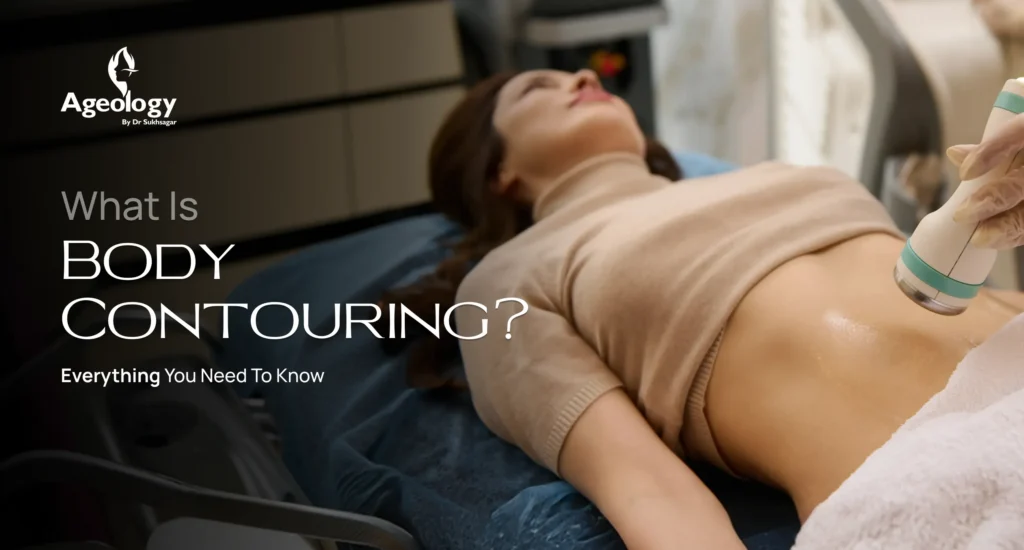
Exercise consistently, eat well, and do everything “right”, and the body still won’t always cooperate sometimes. Stubborn pockets around the abdomen, thighs, or arms tend to hold their ground regardless of effort, and skin elasticity has a way of declining on its own timeline, shaped by age, weight fluctuations, or childbirth.
This is a gap addressed by modern aesthetics. The goal has now shifted to refined, targeted sculpting, and understanding what body contouring actually means is the first step toward using it well. At Ageology, we think about body contouring as an exercise in precision and harmony. We don’t treat it as a substitute for weight loss but as a tool that refines and restores lost muscle tone and tightens lax skin to bring out the structural balance the body already has underneath.
Understanding Body Contouring
So what is body contouring, really? At its core, the meaning of body contouring comes down to a range of medical and aesthetic procedures built to reshape, tone, and firm specific areas of the body. Traditional weight loss shrinks fat cells across the whole body evenly, and there’s no controlling where that reduction shows up first. Body contouring works differently. It targets localised tissue directly to redefine proportions where diet and exercise alone can’t reach.
Broadly, these procedures rely on three biological mechanisms to get there:
- Lipolysis: Reducing or eliminating localised fat deposits.
- Neocollagenesis and elastin stimulation: Heating skin layers to contract existing fibres and trigger new collagen production, which firms up loose skin.
- Hyper-maximal muscle contraction: Stimulating muscle fibres at intensities no manual workout routine could ever replicate.
Non-Invasive vs. Surgical Body Contouring
Before choosing a path, it helps to understand how non-invasive treatments actually differ from surgical ones, since the two solve fairly different problems.
| Feature | Non-Invasive Body Contouring | Surgical Body Contouring |
| Primary Approach | Thermal, ultrasound, radiofrequency, or electromagnetic energy | Incisions, physical removal of fat/skin (e.g., liposuction, tummy tuck) |
| Downtime | Zero to minimal; immediate return to daily activities | May take weeks of recovery and compression garments, and may restrict activity |
| Ideal For | Targeted volume reduction, skin tightening, muscle building, subtle refinement | Major volume removal, extensive skin excision |
| Anaesthesia | None or topical numbing | Local or general anesthesia |
| Result Timeline | Progressive over 4 to 12 weeks as the body processes cell turnover | Immediate structural change, though obscured by swelling initially |
Leading Non-Invasive Technologies at Ageology
Advanced technology now lets us address fat, skin laxity, and muscle tone all at once. Depending on what your body actually needs structurally, a handful of modalities (all available at the Ageology skin clinic in Chandigarh) tend to lead the field:
- High-Intensity Electromagnetic and Radiofrequency (e.g., Emsculpt Neo)
This dual-action protocol pairs synchronised radiofrequency energy with high-intensity focused electromagnetic technology, known as HIFEM. It heats the fat layer enough to permanently destroy fat cells while, at the same time, triggering thousands of supra-maximal muscle contractions. This results in real structural muscle definition as well as a reduction in stubborn fat across areas like the abdomen, buttocks, arms, and calves.
- Radiofrequency Microneedling and Deep Thermal Tightening (e.g., Morpheus8)
Fat reduction on its own can sometimes leave skin looking soft and lax. This is where radiofrequency may work best in delivering thermal energy deep into the dermal and subdermal layers to contract tissue and set off immediate collagen remodelling.
Morpheus8 combines deep RF with subdermal remodelling, which makes it particularly good at smoothing texture, tightening sagging skin, and reshaping fat underneath, both on the face and body.
- Micro-Focused Ultrasound (Ultherapy)
For targeted lifting and tightening, particularly around the neck, décolletage, and lower face, Ultherapy is a form of laser body contouring technology that uses micro-focused ultrasound to reach deep structural tissue layers, right down to the SMAS layer, without ever disturbing the surface. It sets off a gradual, natural production of fresh collagen that continues to build over 3 to 6 months.
Key Benefits of Non-Surgical Body Sculpting
Choosing a non-invasive path offers real advantages for anyone after meaningful aesthetic change without the disruption of surgery.
- Precision targeting: Treatments focus strictly on the stubborn areas diet and exercise never seem to touch.
- No surgery, no scarring: Everything works through the skin barrier, with no incisions and no permanent marks left behind.
- Minimal disruption: Sessions fit into an ordinary workday without forcing you to miss anything.
- Natural-looking progression: Because the body metabolises fat and builds collagen gradually over weeks, the transformation unfolds subtly, the way real change tends to.
- Customisable combination protocols: Different technologies can be layered together to address fat, skin, and muscle within a single treatment plan.
Am I the Right Candidate for Body Contouring?
Non-invasive body contouring works, and it works well, but getting the most out of it depends on going in with realistic expectations.
It’s worth saying plainly: body contouring isn’t a weight-loss treatment, and it isn’t a solution for clinical obesity. It’s built for people who are already near or at their ideal weight but want to deal with stubborn localised pockets, soft tissue laxity, or a lack of muscle definition that diet alone hasn’t resolved.
Ideal candidates generally share a few traits:
- A stable body weight, with a BMI in the normal to slightly overweight range.
- Pockets of subcutaneous fat that resist diet and exercise.
- Mild to moderate skin laxity.
- Realistic expectations about progressive, natural aesthetic improvement.
What to Expect During Your Clinical Journey
At Ageology, we don’t believe in one-size-fits-all treatment. Everybody carries its own structural distribution, its own skin elasticity profile, and its own metabolic rhythm, and the plan should reflect that.
- Step 1: Comprehensive evaluation
Under the guidance of Dr Sukhsagar Ratol and our specialised team of dermatologists, the journey starts with a clinical assessment of your body composition, skin quality, and aesthetic goals. Working with the right body contouring specialist at this stage makes a real difference to the outcome.
- Step 2: Personalised protocol
We curate a tailored treatment plan, often combining technologies like RF, HIFEM, or deep tissue remodelling, to address fat, muscle, and skin all at once.
- Step 3: Treatment sessions
Most non-invasive sessions run between 30 and 60 minutes. You relax comfortably while specialised applicators deliver targeted energy exactly where it’s needed.
- Step 4: Progressive results
Some tightening may show up early, but the deeply structural change typically develops over 2 to 3 months, as the body clears targeted fat cells and builds fresh collagen networks on its own.
Book a consultation with the Ageology team to explore a body-sculpting plan customised entirely to you and your body.
Frequently Asked Questions
How long does body contouring last?Results generally hold for one to three years, depending on the treatment and your lifestyle, though muscle-building effects from something like Emsculpt Neo can last even longer with maintenance.
How painful is body contouring?Most non-invasive treatments cause little to no pain, just mild warmth, pressure, or tingling. Recovery-free, in most cases.
How safe is body contouring?When performed by trained specialists using FDA-cleared technology, like at the Ageology Clinic, body contouring is safe. Non-invasive methods carry minimal risk compared to surgical alternatives.
What is the cost of body contouring in India?Costs may vary widely based on the technology, treatment area, and number of sessions needed. A consultation at Ageology may give you the most accurate estimate for your specific goals.
How many sessions do you need for body contouring?Most protocols need 4 to 6 sessions, spaced a few weeks apart, though this depends on the treatment and your individual goals.