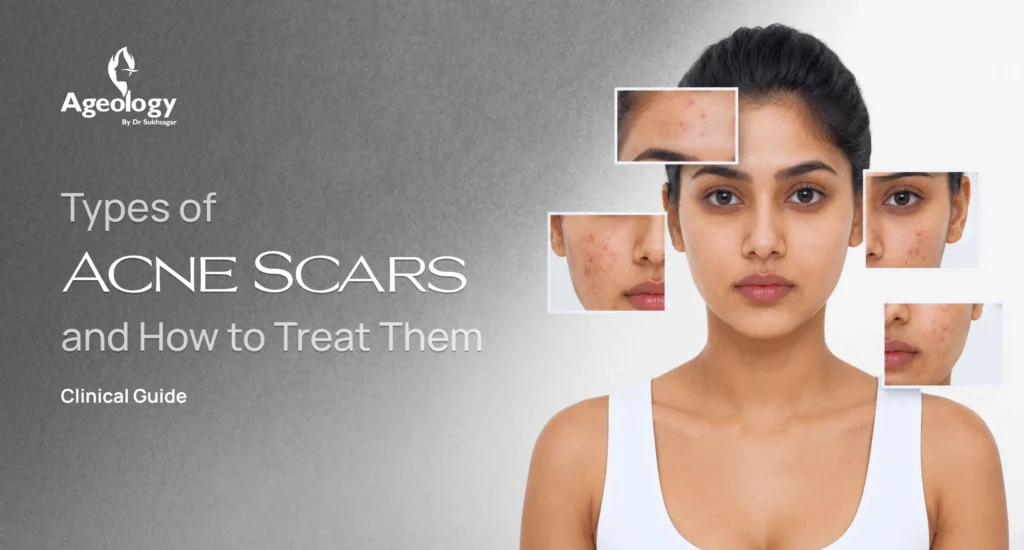
Acne is often considered a problem of the present, but its effects tend to stick around long after the breakout itself has faded. Once the active papules, pustules, and deep cysts finally clear, the skin is often left holding onto an altered landscape of shallow indentations, deep pits, and discoloured patches scattered throughout. Treating this post-inflammation well starts with a simple but often overlooked fact: not all scars are built the same way.
Because skin heals through genuinely different biological pathways depending on the injury, using a method meant for flat surface redness on a deep vertical pit is bound to disappoint. Getting back to smooth skin depends on correctly identifying which types of acne scars you’re actually dealing with and then applying a solution that’s been built for that specific problem.
At Ageology, under Dr Sukhsagar Ratol’s guidance, we treat scar correction almost like a structural project. What follows is a thorough guide to the different types of acne scars and how to treat them, one that tries to honestly combine clinical treatment and home care rather than oversell either.
The Two Main Categories of Acne Scars
When a breakout damages the dermal tissue around it, the body kicks off a fairly complex wound-healing cascade. Depending on how much collagen gets synthesised during that repair process, the resulting scar lands in one of two broad categories:
Atrophic Scars (Depressed Scars): These form from a net loss of tissue and collagen during healing. They make up the large majority of the types of acne scars on face areas.
Hypertrophic and Keloid Scars (Raised Scars): These come from an overproduction of dense, fibrous collagen during the healing process, which pushes raised bumps above the normal skin plane.
| Feature | Atrophic Scars (Depressed) | Hypertrophic & Keloid Scars (Raised) |
| Tissue Volume | Net loss of dermal tissue and collagen | Net excess of dense, disorganised collagen |
| Common Locations | Cheeks, temples, forehead, chin | Jawline, chest, shoulders, upper back |
| Primary Subtypes | Icepick, Boxcar, Rolling Scars | Hypertrophic papules, extended keloid masses |
| Biological Trigger | Destructive inflammation destroying dermal matrix | Overactive wound-healing response with fibrotic tissue |
| Core Treatment Goal | Stimulate neocollagenesis to fill volume deficits. | Degrade excess collagen and flatten tissue contour. |
Types of Acne Scars on Face and Body Explained
Choosing the right treatment path really comes down to identifying the structural geometry of each scar. And it’s rarely just one type; one face may often carry a mix of different types of acne scars at once, which is exactly why personalised diagnosis matters so much.
- Icepick Scars
- Characteristics: Very narrow, under 2 mm wide, deep, sharp depressions that punch vertically into the deep dermis or even the subcutaneous layer. They may appear like small steep holes poked by an icepick.
- Why they form: Severe, narrow inflammation destroys the vertical collagen column that surrounds a hair follicle.
- Treatment complexity: High. Standard surface-level treatments rarely reach deep enough to rebuild tissue at the base of the scar.
- Boxcar Scars
- Characteristics: Round, oval, or angular depressions with sharply defined vertical edges. Depth varies anywhere from shallow (0.1–0.5 mm) to genuinely deep (over 0.5 mm).
- Why they form: Fast tissue destruction following localised inflammatory acne leaves behind a flat, sunken base ringed by otherwise intact skin.
- Treatment complexity: Moderate to high. Rebuilding volume here means stimulating collagen production all the way up to those sharp, defined borders.
- Rolling Scars
- Characteristics: Wide depressions, generally over 4–5 mm, with sloping, soft edges that give the skin a wavy, undulating texture.
- Why they form: Fibrous bands of tissue tether the epidermis down to the subcutaneous tissue beneath it, pulling the skin surface into waves.
- Treatment complexity: Moderate. Those anchoring fibrous bands have to be physically released before any surface smoothing can actually take hold.
- Hypertrophic & Keloid Scars
- Characteristics: Firm, raised, reddish-pink or flesh-coloured growths sitting above the skin’s surface. Keloids go a step further, extending past the boundaries of the original acne lesion entirely.
- Why they form: An overzealous cellular response produces too much collagen during matrix remodelling.
- Treatment complexity: Requires a careful hand; overly aggressive resurfacing here can actually trigger the formation of more scar tissue.
Acne Scar Types and Treatment
Matching acne scar types and treatment correctly is important and often gives us predictable, satisfying results:
| Scar Profile | Depth & Geometry | Ideal Clinical Treatment (Ageology) | Role of Home Care | Expected Clinical Improvement |
| Icepick Scars | Deep vertical puncture (>2mm deep) | Targeted Dermapen Microneedling, Fractional CO₂ Laser, Erbium Laser | Minimal; cannot penetrate deep dermis | 50% – 70% depth reduction |
| Boxcar Scars | Broad depression with sharp edges | Morpheus8 (MNRF), Fractional CO₂ Laser, Dermapen Microneedling | Low; provides mild hydration plumping | 60% – 80% smooth alignment |
| Rolling Scars | Soft, wave-like dermal tethering | Morpheus8 (MNRF) combined with Dermal Fillers & Subcision | Low; cannot sever structural tether bands | 70% – 90% surface elevation |
| Hypertrophic Scars | Raised, firm collagen deposits | Intralesional Steroid Injections, Precision Laser Resurfacing | Moderate; silicone sheets aid flattening. | 60% – 80% volume reduction |
| Post-Acne Marks | Flat surface discolouration (PIH/PIE) | Glycolic Peel, Black Peel, Photofacial (IPL), Hollywood Peel, Hydrafacial | High; botanical brighteners speed fading. | 85% – 100% complete clearance |
Types of Acne Scars and How to Treat Them Naturally: What Science Says
A lot of people, understandably, start by researching types of acne scars and how to treat them naturally. Natural ingredients genuinely have earned their place in preventive skincare and surface soothing, but let’s be honest about what they can and can’t structurally accomplish.
What natural treatments can achieve:
- Fading surface discolouration: Active ingredients like niacinamide, liquorice root extract, rosehip seed oil, and vitamin C help regulate melanin production, which makes them genuinely useful against flat post-inflammatory hyperpigmentation (PIH).
- Reducing inflammation: Botanical antioxidants like green tea extract, aloe vera, and Centella asiatica calm active inflammation and can help head off future scarring before it starts.
- Maintaining epidermal moisture: Natural oils rich in linoleic acid support stratum corneum repair, letting skin reflect light more evenly, which makes shallow texture look a touch softer.
The limits of natural remedies:
- No collagen remodelling: No kitchen ingredient, oil, or DIY paste is going to penetrate 1.5 to 3 millimetres into the dermis to break down tethered fibrous bands or trigger real structural collagen synthesis. That’s simply not how topical application works.
- Risk of sensitisation: Raw ingredients, undiluted lemon juice, garlic, and baking soda throw off the skin barrier’s natural pH and frequently cause contact dermatitis that ends up worsening post-acne hyperpigmentation rather than helping it.
Flat marks do respond to natural brightening agents. Structural depressions like icepick, boxcar, and rolling need targeted clinical intervention to reach deep tissue repair.
Advanced Clinical Treatments at Ageology
At Ageology, Dr Sukhsagar Ratol builds custom treatment plans using multi-modality therapies designed to address several scar depths and types at once:
- Morpheus8 & RF Microneedling: Combines ultra-fine microneedling with deep radiofrequency heat to stimulate collagen and elastin production, lifting depressed boxcar and rolling scars from underneath.
- Dermapen Microneedling with PRP: Combines precision microneedling with concentrated platelet-rich plasma (PRP) growth factors to accelerate cellular repair, smooth skin texture, and promote dermal remodelling.
- Acne Facial: A specialised, clinical-grade facial designed to deeply cleanse pores, extract active comedones, reduce localised inflammation, and gently exfoliate surface buildup to prevent future breakouts and improve overall skin clarity.
- Medical Chemical Peels (Glycolic & Black Peel): Targeted chemical exfoliants shed heavily pigmented surface cells, clear clogged pores, and refine overall skin clarity and smoothness.
- Hydrafacial & Hollywood Peel: Advanced clinical skin therapies that deeply cleanse, exfoliate, and refresh the skin matrix, helping to even out post-acne pigmentation and restore a healthy glow.
Restoring Your Skin Architecture
Understanding the different types of acne scars is the first move toward reclaiming smooth, confident skin. Natural remedies do have a role in soothing surface redness and keeping skin hydrated, especially when recommended by an expert, but rebuilding lost dermal tissue is a job for medical-grade technology.
At Ageology, Dr Sukhsagar Ratol and the clinical team evaluate your specific scar profile and build precise, evidence-based treatment plans aimed at long-lasting structural results.
Medical Disclaimer: The information provided in this blog is intended solely for educational and informational purposes and does not constitute professional medical advice, diagnosis, or treatment. Always seek the advice of a qualified healthcare provider or dermatologist with any questions you may have regarding a medical condition or skin concern.
Frequently Asked Questions
How do I know which type of acne scars I have?Under angled light, deep narrow punctures are icepick scars, steep square dips are boxcar scars, soft rolling waves are rolling scars, flat discoloured spots are post-acne marks, and raised bumps are hypertrophic scars.
Can acne scars go away forever?Yes. Once deep dermal collagen is rebuilt through clinical procedures like subcision or RF microneedling, the newly generated tissue is permanent.
What is stage 4 acne?Stage 4 (severe nodulocystic) acne is an intense inflammatory condition marked by deep, painful cysts and nodules. It carries a high risk of permanent scarring and requires immediate dermatologist care.
Which skincare is best for acne scars?For flat marks, use retinoids, vitamin C, niacinamide, AHAs, and daily SPF. For structural indentations, topical skincare acts only as support for clinical procedures.
What is the #1 acne scar treatment?There is no single “#1 treatment”, as options depend on scar type. However, RF microneedling (like Morpheus8) and fractional CO₂ laser resurfacing are gold standards for broad dermal remodelling.