Millions of people deal with thinning hair, and most of them eventually go looking for regenerative options that don’t involve going under the knife. Two cellular therapies for hair dominate the non-surgical space right now: Platelet-Rich Plasma (PRP) and Growth Factor Concentrate (GFC).
Both draw on your own blood to wake up follicles that have gone dormant, but that’s roughly where the similarity ends: how they’re processed, how stable they are once prepared, and how concentrated their growth factors turn out to be all differ to a great extent. Getting a handle on the understanding of PRP vs GFC is really the first step toward choosing what’s right for your scalp.
At Ageology, hair restoration plans are built under the medical guidance of Dr Sukhsagar Ratol around each patient’s actual hair loss pattern, scalp condition, and medical history.
What Is PRP (Platelet-Rich Plasma)?
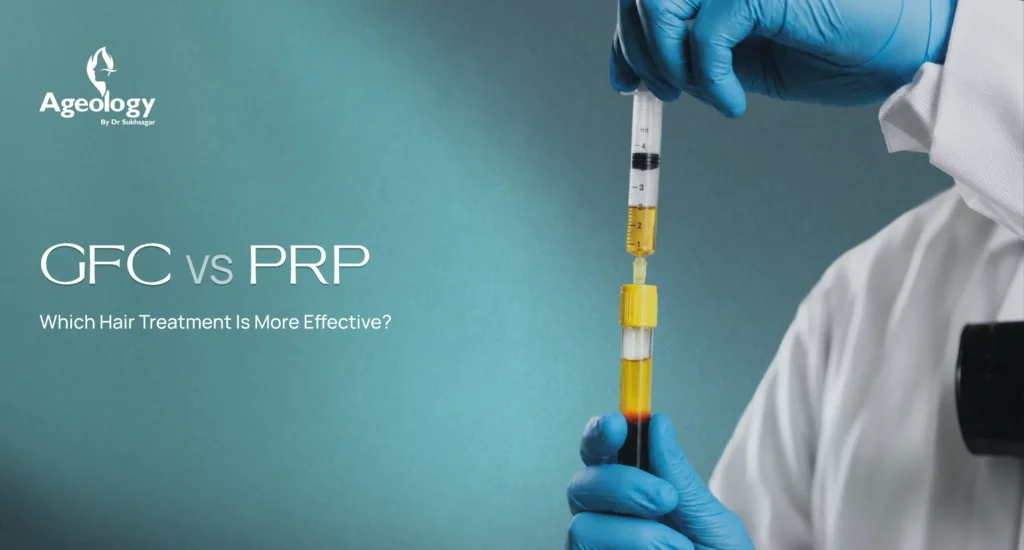
PRP therapy works with healing components already present in your bloodstream. A technician draws a small blood sample and runs it through a centrifuge, which spins at high speed and separates the red blood cells from the plasma. What’s left behind is a layer unusually rich in platelets.
Those platelets carry growth factors, essentially biological signalling molecules. Once injected into the scalp, PRP gets to work repairing tissue locally, improving circulation to roots that have gone dormant, and nudging miniaturised follicles back into an active growth phase.
What Is GFC (Growth Factor Concentrate)?
GFC is, in a sense, the next step forward from PRP. Where PRP isolates whole platelets and lets them release growth factors after the injection, GFC pulls those growth factors out and concentrates them ahead of time, right in the preparation tube.
The process relies on specialised collection tubes containing biochemical activators, which release key growth factors (PDGF, VEGF, EGF, and FGF-2 among them) from the platelets before injection even happens. Red and white blood cells are stripped out entirely, so what remains is a pure, cell-free solution loaded with concentrated growth factors.
Because there are no red or white cells in the mix, GFC tends to cause noticeably less inflammation at the injection site, which usually translates into a smoother, more comfortable procedure.
Benefits of PRP and GFC Treatments
Which therapy suits you better really comes down to your scalp condition, how much discomfort you’re willing to tolerate, and how quickly you want to see results.
- Well Documented Results: PRP has been used across dermatology and regenerative medicine for decades now, so the results are clinically established well.
- Cost-Effective: For anyone testing the waters with non-surgical restoration, PRP is usually the more accessible starting point.
- Genuine Stimulation: By improving local blood flow, it coaxes sluggish, miniaturised roots back into activity.
- Reduces hair shedding: With a consistent course of sessions, PRP tends to stabilise acute hair fall over time.
- Concentrated Dose: Because the growth factors are extracted ahead of time, GFC delivers a purer, more potent solution straight to the roots.
- Higher Comfort: With no cellular material in the mix, there’s far less swelling, redness, or stinging after injection.
- Faster Visible Results: Most patients need fewer total sessions before they notice a real difference in density and texture.
- Consistency: The specialised extraction tubes keep growth factor quality steady from one session to the next.
Key Differences: Comparing GFC vs PRP
Weighing GFC vs PRP for hair restoration comes down to a handful of technical and practical distinctions:
| Parameter | Platelet-Rich Plasma (PRP) | Growth Factor Concentrate (GFC) |
| Preparation | Standard centrifugation to separate platelet-rich plasma | Specialised biochemical activation tubes to release growth factors |
| Purity | Contains platelets along with some white and red blood cells | Completely acellular; contains only concentrated growth factors |
| Stability | Must be injected shortly after preparation | High stability, allowing uniform growth factor delivery |
| Injection Comfort | Mild burning or sting due to cellular components | Generally less painful, with minimal post-procedure swelling |
| Required Sessions | Typically 4 to 6 initial sessions | Typically 3 to 4 initial sessions |
Both approaches deliver genuine regenerative benefits. That said, GFC’s higher concentration and acellular makeup often push it toward the top of the list for patients who want faster results with less discomfort along the way.
PRP GFC Combined Approaches and Expectations
Making sense of PRP GFC options really begins with pinning down what’s actually causing your hair loss in the first place. Androgenetic alopecia, telogen effluvium, and stress-related shedding; the underlying cause matters, since these regenerative therapies work best when matched to the specific stage of loss you’re dealing with.
- Early-stage thinning: Both PRP & GFC are effective here, strengthening weak roots, thickening the hair shaft, and cutting down on active shedding.
- Advanced loss: Once follicle miniaturisation becomes significant, the higher concentration in GFC tends to deliver a stronger wake-up call to dormant roots.
- Consistency: Neither treatment works overnight. Hair follows its own biological rhythm, so most patients start noticing real changes in density and texture only after two or three sessions, spaced out over several months.
The Ageology Approach to Hair Restoration
At Ageology in Chandigarh, Dr Sukhsagar Ratol and the clinical team start every case with detailed trichoscopy, a close look at scalp condition, follicle density, and hair shaft thickness before anything else happens.
Treatment protocols aren’t handed out randomly. They’re chosen or combined based on what the diagnostic data actually shows. Using medical-grade centrifuges and standardised processing kits throughout keeps purity and potency consistent from session to session, which is what ultimately produces safe, natural-looking results.
Ready to restore your hair’s strength and density? Schedule your personal consultation with Dr Sukhsagar Ratol and the medical team at Ageology today!
Frequently Asked Questions
Is GFC more painful than PRP?
Not usually; GFC tends to be less painful overall. Since it’s a refined, cell-free extract with no red or white blood cells, it causes noticeably less tissue irritation and inflammation once injected into the scalp.
Which is costlier, PRP or GFC?
GFC generally runs more expensive per session. That extra cost comes down to the specialised biochemical preparation tubes needed to concentrate the growth factors, plus the more involved extraction process behind them.
Is GFC better than minoxidil?
Minoxidil is a daily topical vasodilator that keeps blood flowing to the follicles, while GFC is an in-office regenerative treatment that delivers concentrated growth factors straight to the roots. GFC and minoxidil tend to complement each other.
Can PRP and GFC be done together?
Both draw on platelet-derived growth factors, but they’re typically kept as separate protocols rather than combined in one session. A dermatologist might still structure a longer-term plan that opens with GFC sessions to get acute shedding under control, then shifts to PRP for ongoing maintenance.
Does GFC regrow hair permanently?
No non-surgical treatment can promise permanent results on its own; genetics and hormonal factors like DHT keep influencing follicles regardless. GFC does meaningfully improve follicle health and restore density, but you’ll still need periodic maintenance sessions to hold onto those gains long-term.