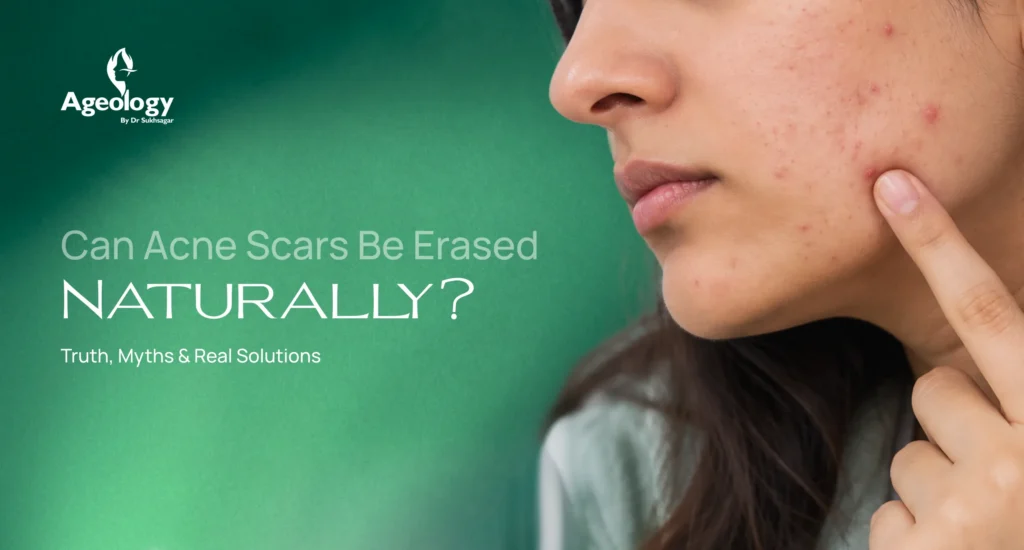
A breakout usually clears up within days, but its impact on your skin may be left behind for long. Long after the redness and swelling settle down, the skin often carries a kind of visual record of the event, sometimes as flat, discoloured patches, other times as genuine structural changes to the skin itself.
Faced with that, it’s only natural to want a gentle, home-based fix first. Search the internet and you’ll find no shortage of promises: rapid transformations built on kitchen staples, botanical extracts, and homemade formulas. So the real question is, can you remove acne scars naturally? Or are these DIY remedies just papering over a deeper dermal issue?
At Ageology, under the medical direction of Dr Sukhsagar Ratol, we look at skin texture and structural damage through the lens of clinical dermatology. Understanding how skin actually heals and where home care stops being useful and medical science needs to step in is the first real step toward clear, even skin.
The Biology of Scarring: Post-Inflammatory Hyperpigmentation vs. True Structural Scars
Before we get into remedies, there’s a distinction worth clearing up, because it gets blurred constantly: the difference between an acne mark and an actual acne scar.
When a breakout happens, the body’s immune response sets off localised inflammation.
- Post-Inflammatory Hyperpigmentation (PIH): When the inflammation stays superficial, it stimulates melanocytes (the cells responsible for pigment) to deposit extra colour. The result is a flat red or brown spot. This is a mark, not a structural scar.
- Structural Scars: When a cyst or papule pushes deep into the dermis, it damages the collagen network underneath. As the wound heals, the body sometimes produces too little collagen, leaving behind depressed “atrophic” scars (icepick, boxcar, or rolling types), or it overcorrects and produces excess fibrous tissue, resulting in raised “hypertrophic” or keloid scars.
This biological difference explains why a topical ingredient might fade a surface spot just fine, yet do absolutely nothing to lift a depressed scar back up to the skin’s original surface.
What DIY Remedies Can and Cannot Do
The urge to remove acne scars naturally often leads people toward pantry remedies like lemon juice, raw honey, aloe vera, rosehip seed oil, and besan (gram flour) paste. These ingredients aren’t worthless, exactly. But their reach is limited by basic skin anatomy, and unfortunately, no amount of enthusiasm changes that.
What natural ingredients can actually do:
- Calm surface redness. Ingredients rich in antioxidants and soothing compounds like aloe vera, green tea polyphenols, and centella asiatica can reduce residual surface redness and calm active inflammation.
- Slow down superficial melanin production. Natural actives like vitamin C (from stable sources), niacinamide, and liquorice root extract can modulate tyrosinase activity, which helps acne mark removal naturally move along a little faster.
- Support hydration and barrier function. Fatty acids in rosehip or jojoba oil support the skin’s outer barrier, making texture look temporarily plumper and smoother.
What natural ingredients cannot do:
- Rebuild lost dermal collagen: Depressed scars are structural voids sitting deep in the dermis, often anchored by rigid fibrous bands (the same bands that subcision is designed to target). No kitchen ingredient penetrates deep enough to trigger real structural collagen synthesis or break those tethers.
- Erase pitting or deep boxcar indentations: Once the elastic fibres and extracellular matrix in the dermis are gone, home remedies simply can’t level the skin’s topography back out.
- Deliver results in a matter of days: Biological skin turnover takes a minimum of 28 to 40 days. So any promise about how to remove acne scars naturally in a week is, frankly, biologically impossible once you’re dealing with true structural scars or deep pigmentation.
It’s also worth a word of caution here: harsher “natural” remedies like raw lemon juice, undiluted apple cider vinegar, and baking soda scrubs may often backfire. These aggressive substances strip the skin barrier, throw off its pH, and can trigger real contact dermatitis, which often makes hyperpigmentation worse instead of better.
Addressing Body Acne: How to Remove Back Acne Scars Naturally
Scars on the body come with their own set of complications. Plenty of people search for how to remove back acne scars naturally, and it makes sense; post-inflammatory marks across the shoulders and upper back are common and stubborn.
Back skin is noticeably thicker than facial skin, has fewer blood vessels, and deals with constant friction from clothing and movement. On top of that, back pores tend to have larger sebaceous glands, which means breakouts there run deeper and scar more easily.
Mild surface pigmentation on the back can respond, over several months, to gentle physical exfoliation, brighteners, and consistent sun protection. But deep textural scarring on the body rarely improves with topical treatment alone. The thicker dermal structure of the back generally needs targeted thermal or mechanical energy to trigger real remodelling.
Identifying Your Acne Scar Profile
Different types of post-acne damage call for different acne treatment strategies. Knowing which profile you’re dealing with makes the difference between realistic expectations and wasted effort.
| Scar Profile | Primary Underlying Mechanism | Visual Presentation | Natural Home Care Outcome | Clinical Solution Required |
| Post-Inflammatory Hyperpigmentation (PIH) | Epidermal/ superficial melanin accumulation | Flat red, brown, or dark purple spots | Fades naturally over months; accelerated by “natural” brighteners | Glycolic Peel, Collagen with Photofacial, Q-Switch Laser |
| Icepick Scars | Narrow, deep vertical loss of dermal collagen | Tiny, deep, sharp pits resembling enlarged pores | Ineffective; depth reaches lower dermis | TCA Peel, Dermapen, Morpheus 8 |
| Boxcar Scars | Broad, sharply defined vertical depressions | Round or oval depressions with steep, defined edges | Ineffective; cannot restore missing tissue volume | Morpheus8, Dermapen, Laser Resurfacing |
| Rolling Scars | Fibrous bands tethering the dermis to subcutis | Soft, wave-like rolling depressions across the cheek | Ineffective; fibrous bands require mechanical release. | Morpheus8 paired with Fillers or Face PRP |
| Hypertrophic Scars | Overproduction of rigid collagen tissue during healing | Raised, firm, flesh-coloured or pink tissue masses | Ineffective; home remedies cannot degrade excess collagen. | Laser resurfacing, Dermapen microneedling |
Where Science Takes Over: Clinical Protocols at Ageology
Once natural remedies hit their biological ceiling, advanced aesthetic dermatology offers something more precise: evidence-based interventions built to rebuild the skin’s structural foundation. At Ageology, Dr Sukhsagar Ratol designs individualised, multi-modality treatment protocols that combine complementary procedures to address every layer of skin damage:
- Acne Scars Treatment: A customised clinical approach using advanced laser resurfacing and dermal remodelling technologies to precisely target scar tissue, promote collagen regeneration, and smooth uneven skin topography.
- RF Microneedling & Morpheus8: Targeted radiofrequency energy delivered deep into the dermis through ultra-fine needles stimulates neocollagenesis (new collagen formation) and elastin production, remodelling skin structure from within while leaving the outer layer largely undisturbed.
- Advanced Laser Resurfacing: Precision lasers create controlled micro-thermal zones in damaged tissue, breaking down old scar tissue and prompting the skin to rebuild a smoother, more evenly pigmented dermal matrix.
- Medical Chemical Peels (Glycolic, Black Peel): Clinical-grade AHA and BHA solutions drive controlled exfoliation, shedding pigmented surface cells and smoothing out minor textural irregularities.
The Bottom Line
Wanting to remove acne scars naturally is an understandable first instinct, but expectations need to line up with biological reality. Natural ingredients and gentle home care genuinely can soothe active inflammation and speed up mark fading. Deep structural scars, though, need structural solutions, and there’s no way around that.
Your path to clearer skin doesn’t have to run through years of trial-and-error home remedies. At Ageology, Dr Sukhsagar Ratol and our dermatology team use thorough diagnostic evaluation to pinpoint your exact scar type and build a customised, evidence-based plan around your skin’s actual needs.
Take the first step toward lasting skin confidence.
Book your personalised scar evaluation at Ageology today.
Medical Disclaimer: The information provided in this blog is intended solely for educational and informational purposes and does not constitute professional medical advice, diagnosis, or treatment. Always seek the advice of a qualified healthcare provider or dermatologist with any questions you may have regarding a medical condition or skin concern.
Frequently Asked Questions
Can acne scars be 100% removed?
Complete removal back to pre-scar skin is rare, but modern clinical treatments can improve scar appearance, depth, and texture by roughly 70% to 90%. The real goal of advanced dermatology isn’t perfection; it’s blending the scar into surrounding healthy tissue until it’s no longer something people notice.
How to remove acne scars fast?
Dermal remodelling takes time, but the fastest, safest path runs through combined clinical treatments, fractional laser resurfacing, chemical peels, and RF microneedling. Natural remedies simply can’t move that quickly, since collagen production inherently takes several weeks to build.
What do Koreans do for acne scars?
Korean dermatology leans heavily on early prevention, barrier preservation, and layered clinical care. Common protocols include gentle chemical peels, microneedling with growth factors or PDRN (salmon DNA), picosecond lasers, and deep hydration treatments like Hydrafacial to keep skin resilient while addressing scarring.
Can cucumber remove acne scars?
Not really. Cucumber is mostly water with a few mild vitamins enough to soothe surface redness and add hydration temporarily, but nowhere near potent enough to break down excess melanin or rebuild collagen in true scars.
Do acne scars fully fade?
Post-inflammatory hyperpigmentation usually does fade fully over time with sun protection and consistent skincare. Structural scars, whether depressed or raised, don’t fade on their own, because the underlying collagen network has been permanently altered.