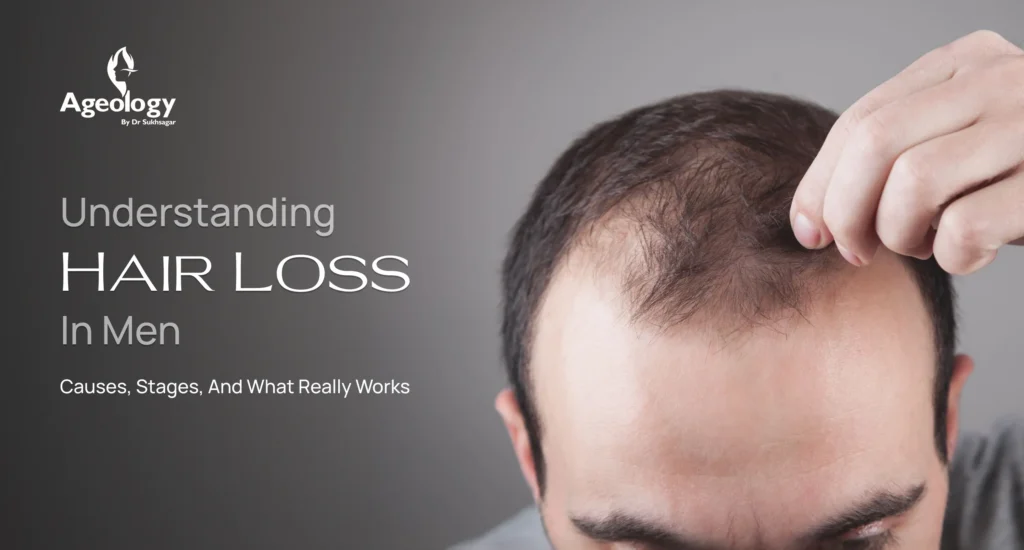
There’s a particular kind of dread that comes with noticing more hair than usual in the shower drain or catching your hairline in a photo and realising it’s sitting a little further back than you remember. For most men, hair isn’t just hair; it’s tangled up with how they see themselves and how old they feel. So the instinct, when thinning starts, is to reach for something fast: a new shampoo, a scalp oil routine borrowed from a YouTube video, or whatever remedy is trending that month.
The trouble is, hair fall in men is rarely that simple. It’s rarely one isolated problem you can shampoo your way out of. It’s a biological chain reaction including genetics, hormones, metabolic health, day-to-day habits, and even how well blood reaches your scalp, which all play a part.
At Ageology, under the guidance of Dr Sukhsagar Ratol, a board-certified aesthetic practitioner and dermatologist, male thinning is approached the way clinical dermatology demands: methodically, and without shortcuts. Getting to why hair fall occurs in male patients in the first place is really the starting point for everything else, like stopping the loss, protecting what’s still there, and eventually rebuilding density.
How Much Hair Fall Is Normal for Men?
Before diving into causes, it’s worth answering a question many men quietly wonder about: how much hair fall is normal in men, really? Not every strand of hair on your pillow is a reason to worry.
Each follicle on your scalp runs through its own independent cycle, made up of three phases:
- Anagen (growth phase): This is the active stretch, lasting anywhere from two to six years, where the follicle is dividing cells and producing a healthy shaft.
- Catagen (transition phase): A short, roughly two-week window where the follicle contracts and separates from its blood supply.
- Telogen (resting phase): Lasting two to four months, this is where the old hair just sits until a new one growing beneath it eventually pushes it out.
Since somewhere around 80–90% of your hair sits in that active anagen phase at any moment, losing 50 to 100 strands a day is well within the normal range; that’s just the resting hair cycling out. But if you’re noticing broad thinning across the scalp, a hairline receding at the temples, or noticeably more hair on the pillow each morning, that’s a different situation. At that point you’re likely looking at progressive hair loss in men, not the ordinary background shedding everyone experiences.
Reasons for Hair Fall in Men
This is the question that actually matters. What is the reason for hair fall in male cases isn’t a single answer; it depends on which underlying mechanism is driving the thinning. Broadly, the reasons for hair fall in men fall into a handful of distinct categories:
- Androgenetic Alopecia (Male Pattern Baldness)
This one accounts for more than 95% of progressive hair loss in men, making it by far the most common answer to what is the reason of hair fall in male patients. It’s hereditary, and it’s driven by dihydrotestosterone (DHT), an androgen your body produces from testosterone through an enzyme called 5-alpha reductase.
Men who are genetically predisposed have follicles around the hairline, temples, and crown that carry an unusually high number of androgen receptors. When DHT attaches to those receptors, it shortens the anagen growth phase and gradually shrinks the follicle, a process that dermatologists refer to as ‘follicular miniaturisation’. Over enough growth cycles, thick terminal hairs slowly turn into fine, pale, almost invisible vellus hairs, until eventually the follicle stops producing anything at all.
- Telogen Effluvium (Stress and Metabolic Shock)
Sometimes it isn’t genetics at all, but shock. A high fever, sudden weight loss, major surgery, chronic anxiety, or a bad viral infection can jolt up to 30% of your actively growing hairs into the resting Telogen phase all at once.
The result is diffuse shedding across the whole scalp, usually showing up two to three months after whatever triggered it. Unlike pattern baldness, this type tends to resolve on its own once the underlying stressor is identified and dealt with.
- Nutritional Deficiencies and Metabolic Dysfunction
Hair matrix cells divide faster than almost any other cell in the body, which makes them vulnerable to nutritional gaps. A few deficiencies are often among the reasons for hair fall in men:
- Iron and serum ferritin: low stores mean less oxygen reaching the roots.
- Vitamin D3: plays a key role in kicking off the anagen growth phase.
- Zinc and essential amino acids: the raw materials keratin is built from.
- Protein deprivation: when dietary protein runs low, the body starts conserving amino acids by pulling follicles out of active growth.
- Chronic Scalp Inflammation and Microbial Imbalance
Hair doesn’t grow well on unhealthy tissue. Seborrhoeic dermatitis, persistent dandruff, or fungal overgrowth all create low-grade inflammation right around the follicle root. Over time, that inflammation generates oxidative stress that weakens the follicle’s anchor and speeds up shedding.
- Poor Scalp Circulation and Everyday Habits
Smoking, high-glycaemic diets, chronic sleep deprivation, and elevated cortisol all narrow the tiny capillaries feeding the scalp. Without solid blood flow, follicles go without the oxygen and nutrients they need, and in areas that are already genetically vulnerable, this considerably speeds up miniaturisation.
Mapping the Progression: The 7 Stages of Male Pattern Hair Loss
Male pattern thinning doesn’t happen randomly; it tends to follow a fairly predictable path, mapped clinically on the Norwood Scale. Knowing which stage you’re at helps you decide whether conservative management is enough or whether it’s time for something more aggressive.
| Norwood Stage | Visual Presentation & Clinical Profile | Primary Objective |
| Stage 1 | Minimal or no visible hairline recession; density remains intact | Prevention & Maintenance |
| Stage 2 | Slight temporal recession; classic triangular “maturing” hairline | Early Intervention & DHT Control |
| Stage 3 | Deep temporal recession forming an M, U, or V shape; early crown thinning may begin. | Follicular Stabilisation & Growth Activation |
| Stage 4 | Marked temporal recession plus a noticeable vertex bald spot, separated by a band of hair | Intensive Regenerative Medical Protocol |
| Stage 5 | The band separating temples and the crown narrows further as bald regions expand. | Advanced Combination Therapy |
| Stage 6 | The bridge across the crown disappears entirely, leaving one large bare area. | Density Restoration & Strategic Coverage |
| Stage 7 | Only a thin horseshoe band remains along the sides and back. | Surgical Evaluation / Scalp Management |
Beyond DIY: Clinical Treatments at Ageology
Anti-hair-fall shampoos and home remedies tend to disappoint for a straightforward reason: they can’t touch systemic hormone levels or reverse follicles that are already miniaturised. If you’re genuinely trying to pin down the reason for hair fall in male cases you’re dealing with, a bottle off a pharmacy shelf usually isn’t going to give you that answer.
At Ageology, Dr Sukhsagar Ratol uses an evidence-based, multi-modal diagnostic model rather than a generic script. That means looking at scalp blood supply, relevant serum biomarkers, family history, and follicle health under magnification before building a protocol around your specific profile:
- QR 678: A cocktail of growth factors & nutrients to stimulate hair regrowth.
- Autologous PRP and growth factor therapy: growth factors drawn from your own blood, concentrated, and then micro-injected into the scalp to wake dormant follicles, extend the anagen phase, and thicken hairs that have started to miniaturise.
- Scalp microneedling and mesotherapy: controlled micro-channels that trigger the body’s own healing response, boost collagen at the follicle level, and allow peptide formulations to reach the hair bulb directly.
The Bottom Line
Getting clear on why hair fall occurs in male patients the first real step toward protecting whatever density you still have. Genetics undeniably plays a large role in male pattern Early medical intervention can slow baldness and, in many cases, reverse it by bringing miniaturising follicles back to life and restoring meaningful density.
You don’t have to spend years cycling through home remedies that never quite deliver.
Book a comprehensive hair evaluation at Ageology with Dr Sukhsagar Ratol and get an evidence-based plan for hair & scalp health restoration built around your biology.
Medical Disclaimer: The information provided in this blog is intended solely for educational and informational purposes and does not constitute professional medical advice, diagnosis, or treatment. Always seek the advice of a qualified healthcare provider or dermatologist with any questions you may have regarding a medical condition or skin concern.
Frequently Asked Questions
What is the main cause of hair loss in men?
The leading cause is androgenetic alopecia, or male pattern baldness, a genetic sensitivity to DHT that gradually shrinks follicles, shortening their growth cycle until hair grows thinner and thinner and eventually stops altogether.
How can I stop hair fall in a male?
Stopping active shedding starts with identifying its actual cause. Clinical protocols usually combine medically supervised DHT blockers, topical growth stimulants, treatments like PRP or mesotherapy, and targeted nutritional correction.
What should you eat to stop hair fall?
No diet reverses genetic baldness on its own, but nutrition still matters enormously. Prioritise protein (eggs, lean meat, legumes, and fish), along with iron, zinc, omega-3s, and vitamin D3, the building blocks follicles need for healthy keratin production.
Can men recover from hair loss?
Yes, particularly when intervention happens during the early-to-moderate stages (Norwood 2 through 4). Fully closed follicles generally require surgical transplantation, while miniaturised or resting follicles often respond well to targeted medical and regenerative treatments.
How to stop hair loss naturally?
Focus on what supports scalp health day to day: managing stress, eating enough protein, massaging the scalp to encourage circulation, easing off aggressive heat styling, and treating any underlying scalp conditions like dandruff. That said, natural methods rarely stop DHT-related miniaturisation driven by genetics on their own.
ReferencesNORWOOD, O.T.T., 1975. Male pattern baldness: classification and incidence. Southern medical journal, 68(11), pp.1359-1365.