Shaving is a chore. Waxing hurts. Epilating leaves your skin blotchy for a day, and no matter which razor you buy, the ingrown hair always seems to find its way back. If you’ve been stuck in that cycle for years, you’ve probably already looked into laser hair removal as a way out.
And then the questions follow: Is laser hair removal safe? Will it burn your skin? Are there side effects nobody talks about, or is the whole thing just a beauty trend dressed up in scientific-sounding language?
At Ageology, under the guidance of Dr Sukhsagar Ratol, a board-certified practitioner with fellowship training in aesthetic medicine, we answer all your questions honestly. The short answer is yes, laser hair removal is safe, provided it’s done with FDA-approved technology by people who actually understand skin. The longer version (below) is worth reading before you book an appointment for laser hair removal.
What Is Laser Treatment for Hair Removal?
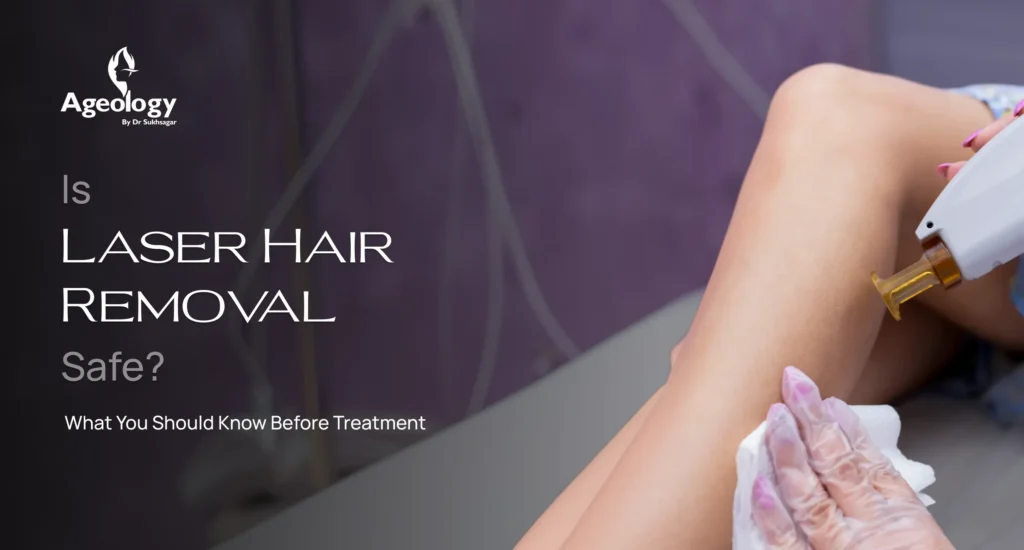
Before getting into the safety question, it helps to know what is laser treatment for hair removal in the first place. In simple terms, it’s a light-based procedure that uses a concentrated beam set to a specific wavelength. That beam is absorbed by melanin (the pigment sitting inside your hair follicle) and converted into heat right at the root.
The process rests on a principle dermatologists call selective photothermolysis, which is a fairly simple idea:
- The light finds its target: the laser is calibrated to a wavelength that melanin soaks up far more readily than surrounding tissue.
- Heat does the work: the absorbed energy turns into localised heat, damaging the hair bulb and the stem cells that feed it.
- Growth stops: Once those stem cells are compromised, the follicle can no longer produce hair the way it used to.
How Safe Is Laser Hair Removal?
The word that matters most here is selective. Medical-grade devices fire in pulses measured in milliseconds. The energy doesn’t travel to your bloodstream, your organs, or anywhere below the upper skin layers. It stays exactly where it’s aimed.
That’s a large part of why the procedure has such a strong safety track record when handled correctly. The risk in laser hair removal was never really about the laser itself; it’s about who’s holding the handpiece. And with a professional like Dr Suksagar Ratol, you are in safe hands.
Myths That Keep People From Trying Laser Hair Removal
A lot of the fear around this treatment comes from outdated information circulating online. Let’s go through the ones we hear most often.
- “It causes radiation exposure or cancer.”
Not true. Laser hair removal devices use non-ionising light. Unlike X-rays or gamma radiation, non-ionising energy doesn’t alter cellular DNA, and it carries no cancer risk. It works only at the surface level, heating pigment, nothing more.
- “It isn’t safe for Indian or darker skin tones.”
This was a fair concern years ago. Older laser systems struggled to tell the difference between melanin in the hair and melanin in the surrounding skin, which sometimes led to burns or dark patches. That gap has now been closed. Long-pulse Nd:YAG lasers now use longer wavelengths that pass through surface pigment and target the hair bulb directly, which makes treatment reliable across the full range of Fitzpatrick skin types.
- “One session and you’re done forever.”
Also false, unfortunately. Hair cycles through three phases: anagen (active growth), catagen (transition), and telogen (resting), and lasers can only disable a follicle while it’s in that active anagen phase. Since only a fraction of your hair sits in that phase at any given moment, most people need somewhere between 6 and 8 sessions, spaced four to six weeks apart, to see lasting results.
- “It’s unbearably painful.”
Most patients compare the feeling to a small elastic band flicking the skin, paired with a brief warm sensation. Modern machines come with built-in cooling tips that chill the treatment area before and after every pulse, which keeps discomfort to a minimum for the vast majority of people.
Is Laser Hair Removal Safe for Face and Sensitive Areas?
This is one of the most common questions we get, and understandably so; facial skin is thinner, more visible, and more reactive than skin elsewhere on the body. So is laser hair removal safe for face use, or is laser hair removal treatment safe for the face specifically when it comes to the upper lip, chin, and jawline?
Generally, yes, facial laser hair removal is safe when the device settings and wavelength are matched to your skin type and the practitioner has experience treating that particular area. Because facial skin sits close to the eyes and tends to be more sensitive, protective eyewear and lower, more conservative energy settings are standard practice. The face also tends to respond faster to hormonal shifts, so a proper consultation matters more here than almost anywhere else on the body.
What’s Normal and What Isn’t
Even with a well-run procedure, your skin will react. Understanding the difference between an expected response and a warning sign is part of going in prepared.
Expected, temporary reactions:
- Mild redness and small raised bumps around each follicle, similar in appearance to a light sunburn, usually gone within a day.
- A warm, faintly tingling sensation that fades once cooling gel is applied.
Rare complications (almost always tied to inexperienced operators or uncalibrated equipment):
- Burns or blistering, typically from energy settings that don’t match the person’s skin tone.
- Hyperpigmentation or hypopigmentation: patches of skin darkening or lightening, often triggered by sun exposure too close to treatment.
- Paradoxical hypertrichosis, a rare and counterintuitive outcome where fine facial hair thickens instead of thinning, generally linked to underpowered devices like home IPL units.
Getting Ready for Laser Hair Removal: Before and After
Before your session:
- Stay away from waxing, plucking, or threading for three to four weeks beforehand. The follicle needs its root intact for the laser to have anything to target.
- Shave the area roughly 12 to 24 hours ahead of time. Surface hair left in place can absorb the laser’s energy and scorch the skin instead of letting it reach the follicle.
- Skip tanning beds and direct sun for about two weeks prior; tanned skin raises the risk of pigment changes.
- Pause retinoids, AHAs, BHAs, and any aggressive exfoliants for three to five days before your appointment.
After your session:
- A cooling gel or plain aloe vera can settle any residual heat.
- Hold off on saunas, hot tubs, steam rooms, and intense workouts for a day or two; trapped heat can aggravate freshly treated skin.
- Sunscreen, SPF 30 or higher, becomes non-negotiable on any exposed treated area.
- Between sessions, shaving is fine. Waxing, tweezing, and hair-removal creams are not, since they disturb the follicle the laser needs to find later.
Why the Provider Matters More Than the Machine
The safety of laser hair removal depends more on who is operating the device than on the device itself. Salon-grade setups often rely on one-size-fits-all settings and equipment that lacks FDA clearance, which leaves no room to account for your specific skin depth, hormonal profile, or hair density.
At Ageology, every treatment plan starts with a real consultation, led by Dr Sukhsagar Ratol. We consider your medical history, skin type, hair texture, and any hormonal factors, including conditions like PCOS, that may influence hair growth before a single setting is chosen. Our technologically advanced treatments are US FDA-approved and equipped with integrated cooling systems. Every parameter, wavelength, pulse duration, and spot size is adjusted to your individual profile rather than applied generically. That level of customisation covers the face, underarms, chest, back, arms, legs, bikini line, and the full body.
The Bottom Line
Is laser hair removal safe? For the overwhelming majority of people, yes, when it’s performed with proper equipment, by someone trained to read your skin rather than guess at it. The technology itself is precise; the variable that actually determines your outcome is expertise.
If you’re tired of temporary fixes that leave your skin irritated week after week, it might be time to consider something that’s actually built to last.
Ready for smooth, hassle-free skin?
Book Your Personalised Laser Consultation with Dr Sukhsagar Ratol at Ageology Today.
Medical Disclaimer: The information provided in this blog is intended solely for educational and informational purposes and does not constitute professional medical advice, diagnosis, or treatment. Always seek the advice of a qualified healthcare provider or dermatologist with any questions you may have regarding a medical condition or skin concern.
Frequently Asked Questions
Is laser treatment for hair removal safe?
Yes. When performed with FDA-approved lasers and correctly calibrated settings, it’s considered one of the safer cosmetic procedures available, with only mild, short-lived side effects for most patients.
Is laser treatment for hair removal safe for all skin types?
Modern devices, particularly long-pulse Nd: YAG systems, are built to treat a wide range of skin tones safely, including deeper Fitzpatrick types that older lasers struggled with.
Does laser hair removal hurt more on the face than the body?
Facial skin is more sensitive, so practitioners typically use gentler settings there, but most patients describe the sensation as mild snapping or warmth rather than significant pain.
How many sessions does it actually take before hair stops growing back?Most people need 6 to 8 sessions spaced four to six weeks apart, since lasers can only target hair that’s currently in its active growth phase.
Can I get laser hair removal if I have darker skin or a tan?
Darker skin tones can undergo laser hair removal safely with the right wavelength technology, but active tanning right before treatment should be avoided, as it raises the risk of pigment changes.