A breakout rarely ends the moment the underlying lesion heals. Long after the active inflammation has calmed down, the skin often holds onto some visual reminder of the event. For many people, these leftover blemishes become a genuine source of frustration, leading to endless experimentation with topical creams, serums, and home remedies, all chasing the same promise of a smooth, even complexion.
More often than not, though, treatment plans fail for a much simpler reason: people never really understand the difference between acne marks vs. acne scars in the first place. The two terms get thrown around interchangeably in everyday conversation, but they describe two entirely different biological events. Treat a flat surface discolouration with a procedure meant for deep dermal tissue loss, and you’ll be disappointed. Apply a brightening serum to a deep structural pit, and you’ll see no change in skin topography at all, because that’s simply not what it’s built to fix.
At Ageology, under the guidance of Dr Sukhsagar Ratol, we assess skin density, texture, and pigmentation through a clinical lens. Understanding the underlying mechanics of acne and scars is the first step toward choosing a treatment plan grounded in science.
What Are Acne Marks and Acne Scars?
To make sense of your options, it helps to nail down the precise acne marks meaning alongside the biological definition of a true structural scar.
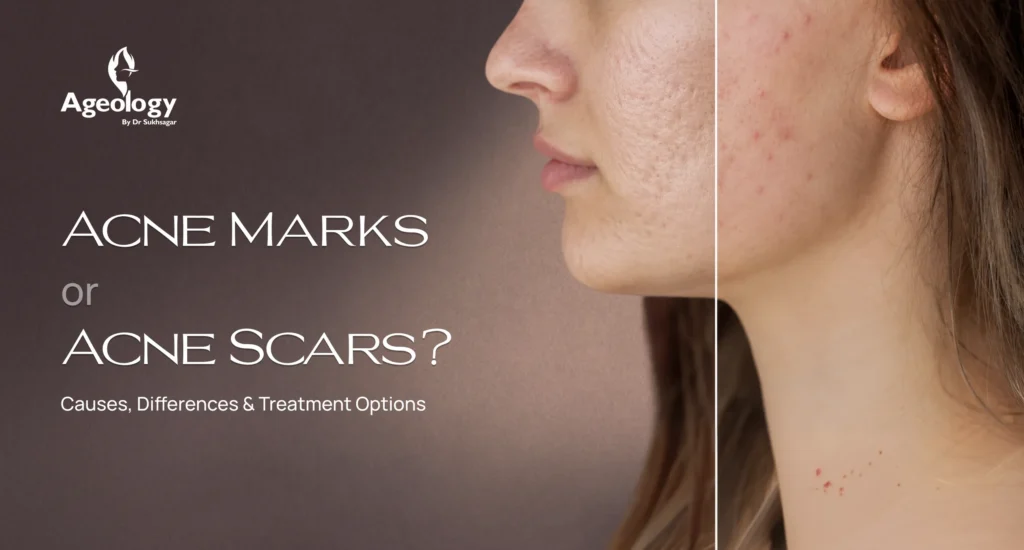
When people ask, “What are acne marks?”, they’re usually pointing at post-inflammatory changes in skin pigment. Once an acne lesion becomes inflamed, the body sends immune cells to fight bacteria and repair the damaged tissue. When the active pimple finally disappears, the skin can be left with a flat, temporary patch of discolouration. The surface itself may stay completely smooth to the touch; there’s no change to its depth or contour, and there’s nothing physically different about it.
Structural scars are entirely different. They form when inflammation pushes deep into the dermis and permanently damages or reshapes the collagen network underneath. As the skin tries to repair that deeper injury, it either produces too little collagen, leaving a depressed, atrophic scar, or too much disorganised collagen, resulting in a raised, hypertrophic scar.
Understanding this core distinction between acne marks and acne scars is essential for setting realistic expectations and ensuring effective treatment.
Acne Scars & Acne Marks: Causes and Mechanisms
How a breakout leads to lasting damage depends on how deep the inflammation reaches into the layers of skin.
| Feature | Post-Inflammatory Hyperpigmentation (PIH / Acne Marks) | Atrophic or Hypertrophic Acne Scars |
| Affected Layer | Epidermis & Superficial Dermis | Deep Dermis & Subcutaneous Tissue |
| Structural Impact | None; the skin surface remains completely flat. | Permanent indentation (atrophic) or elevation (raised) |
| Biological Trigger | Melanocyte hyperactivation or capillary dilation | Net loss or excess of dermal collagen architecture |
| Visual Presentation | Flat red, pink, purple, or dark brown spots | Pits, boxcar depressions, rolling waves, or firm bumps |
| Resolution Timeline | Months to a year (reversible) | Permanent without procedural collagen remodelling |
The Biology Behind Acne Marks
Acne marks generally split into two clinical categories, largely based on skin tone and vascular response:
- Post-Inflammatory Hyperpigmentation (PIH): More common in darker skin phototypes. Localised inflammation overstimulates melanocytes (the pigment-producing cells, causing them to overproduce melanin. What’s left behind is a flat brown, dark brown, or black spot.
- Post-Inflammatory Erythema (PIE): More common in lighter skin phototypes. Here, the microscopic blood vessels near the skin’s surface dilate or break during the inflammatory phase of a lesion, leaving flat pink, red, or purple marks.
The Biology Behind Acne Scars
When a deep papule, pustule, or nodulocystic lesion ruptures, it causes structural trauma in the deeper dermal layer. And this point is really where the difference between acne scars and acne marks becomes clearest; it’s a matter of what happens to the structural matrix itself:
- Atrophic Scars (Depressed): If the inflammatory process destroys dermal collagen and subcutaneous fat, the skin heals with a volume deficit. This process is what produces icepick scars (narrow, deep vertical punctures), boxcar scars (broad depressions with sharp edges), and rolling scars (soft, wave-like depressions held down by fibrous tethers).
- Hypertrophic & Keloid Scars (Raised): If the body overcorrects during healing, it lays down an excess of dense, fibrotic collagen, creating raised, firm bumps that sit above the normal skin line.
Difference Between Acne Marks and Acne Scars
Understanding the key distinctions between acne marks and scars is what allows you to choose the right approach:
| Characteristic | Acne Marks (PIH / PIE) | Atrophic Acne Scars | Hypertrophic / Keloid Scars |
| Surface Texture | Smooth and flat | Sunken, pitted, or indented | Raised and elevated |
| Primary Cause | Excess melanin or capillary dilation | Dermal collagen destruction | Excess collagen accumulation |
| Common Locations | Anywhere an acne lesion occurred | Cheeks, temples, chin | Jawline, chest, upper back |
| Tactile Sensation | Identical to normal skin | Depressions felt upon touching | Firm, raised bumps felt on skin |
| Spontaneous Fading | Fades naturally over time | Permanent without treatment | Permanent without treatment |
| Core Treatment Focus | Melanin inhibition & cell turnover | Neocollagenesis & tissue lifting | Collagen breakdown & tissue flattening |
Acne Treatment Options at Ageology
Because acne marks and scars develop through such different mechanisms, their treatments have to be tailored just as differently. At Ageology, Dr Sukhsagar Ratol builds customised, multi-modality treatment plans that use advanced, medical-grade therapies.
Targeted Solutions for Acne Marks (PIH & PIE)
Since acne marks live in the superficial layers of skin, treatment here focuses on speeding up cellular turnover, breaking down excess melanin, and calming vascular redness:
- Medical Chemical Peels (Glycollic Peel & Black Peel): Clinical-grade exfoliants shed dead surface cells loaded with excess melanin, speeding cell renewal and helping restore an even tone.
- Photofacial (IPL Therapy): Intense Pulsed Light zeroes in on dark melanin deposits and constricted capillaries, effectively fading red and brown post-acne discolouration.
- Q-Switched Laser: A specialised laser that shatters surface epidermal pigment into microscopic particles, which the body then clears away naturally.
- Hydrafacial: A medical-grade hydro-dermabrasion process that cleanses deeply, exfoliates, and infuses the skin with antioxidants to support barrier repair and overall clarity.
Targeted Solutions for Structural Acne Scars
Reversing actual structural change means working deep inside the dermis, breaking down damaged tissue, lifting tethered skin, and stimulating fresh collagen synthesis:
- Acne Scars Treatment: A customised clinical approach that uses advanced laser resurfacing and dermal remodelling technologies to precisely target scar tissue, promote collagen regeneration, and smooth uneven skin topography.
- Morpheus8 & RF Microneedling: Pairs ultra-fine microneedling with deep radiofrequency heat to stimulate collagen and elastin production, lifting depressed boxcar and rolling scars from underneath.
- Dermapen Microneedling with PRP: Combines precision microneedling with concentrated platelet-rich plasma growth factors drawn from your own blood, accelerating cellular repair and smoothing texture.
- Acne Facial: A specialised, clinical-grade facial designed to deeply cleanse pores, extract active comedones, reduce localised inflammation, and gently exfoliate surface buildup, preventing future breakouts and improving overall skin clarity.
The Bottom Line
Understanding the difference between acne marks vs. acne scars is what separates wasted effort from successful skin restoration. Flat surface discolouration resolves naturally over time, and you can safely speed up that process with medical peels, photofacials, and the right skincare. True structural indentations are a different matter; they require specialised clinical therapies specifically designed to rebuild lost dermal collagen.
At Ageology, Dr Sukhsagar Ratol and the dermatology team conduct comprehensive skin evaluations to pinpoint your exact scar profile, so you receive an evidence-based, genuinely personalised treatment plan rather than a one-size-fits-all guess.
Medical Disclaimer: The information provided in this blog is intended solely for educational and informational purposes and does not constitute professional medical advice, diagnosis, or treatment. Always seek the advice of a qualified healthcare provider or dermatologist with any questions you may have regarding a medical condition or skin concern.
Frequently Asked Questions
How do I remove acne marks?
Removing flat acne marks involves speeding up epidermal cell turnover and inhibiting melanin synthesis. Clinical chemical peels (Glycolic or black peels), photofacials (IPL), and Hollywood Peels all clear superficial pigment effectively, while daily broad-spectrum sun protection keeps existing marks from darkening further.
Do acne marks turn into scars?
No. Flat acne marks, PIH or PIE, don’t evolve into structural scars over time. Marks are temporary changes in surface pigment or vascular response, while scars come from actual collagen loss or tissue destruction happening during the original active breakout.
Can toner remove acne marks?
Toners with exfoliating actives like glycolic acid, salicylic acid, or niacinamide can help with mild surface exfoliation and general brightening. That said, toners alone are rarely strong enough to fully clear deep, stubborn post-inflammatory hyperpigmentation on their own.
How to tell if it’s acne scars or acne?
Active acne shows up as inflamed, tender, red, or pus-filled bumps, papules, pustules, and cysts caused by clogged pores and active bacteria. Acne scars, by contrast, are inactive and non-tender: permanent texture changes (depressions or raised bumps) that stick around long after the infection itself has cleared.
Can acne scars be 100% removed?
Complete restoration to pre-scar skin is rarely realistic, but modern multi-modality procedures, Morpheus8, fractional lasers, and PRP microneedling, among them, routinely achieve 70% to 90% improvement, blending scars smoothly into the surrounding healthy skin.